


Cabins off the grid, RVs on the move, and homes facing storm-driven outages all share one concern, which is keeping essentials running when the power goes out. A portable power station has become a common way to meet that need, since it stores energy that can be carried, plugged in, and recharged without fixed wiring. bluettipoweraaa offers a range that spans compact single-unit stations and larger systems that expand with added battery packs, covering RV travel, cabin living, and home backup in one lineup.
Understanding Portable Power Stations vs. Home Battery Systems
A station is typically a self-contained unit, with a battery, inverter, and charge controller built into one case that moves wherever it is needed. Home battery systems, on the other hand, are usually fixed installations wired directly into a property’s electrical panel. Some portable units now include surge capacity and automatic switching once reserved for stationary setups, so the line between the two categories has become less rigid. bluettipoweraaa covers both sides of that comparison, with the Elite 300 built for portability and the Apex 300 designed to expand into larger home setups.
The Elite 300: Compact 3 kWh Power for RVs and Remote Cabins
bluettipoweraaa markets the Elite 300 as the world’s smallest 3 kWh portable power station, fitting the footprint of a 2 kWh unit while holding 3,014Wh of capacity. Continuous output reaches 2,400W, with a lifting capability up to 4,800W for heavier loads such as microwaves and space heaters. For RV use, it includes a TT-30 outlet alongside a 12V/30A DC port for lights and small appliances. A built-in UPS function switches over in under 10 milliseconds, which can keep security systems, aquariums, and workstations powered through brief interruptions.
The Apex 300: Scalable Power from 2.7 kWh to 100+ kWh Capacity
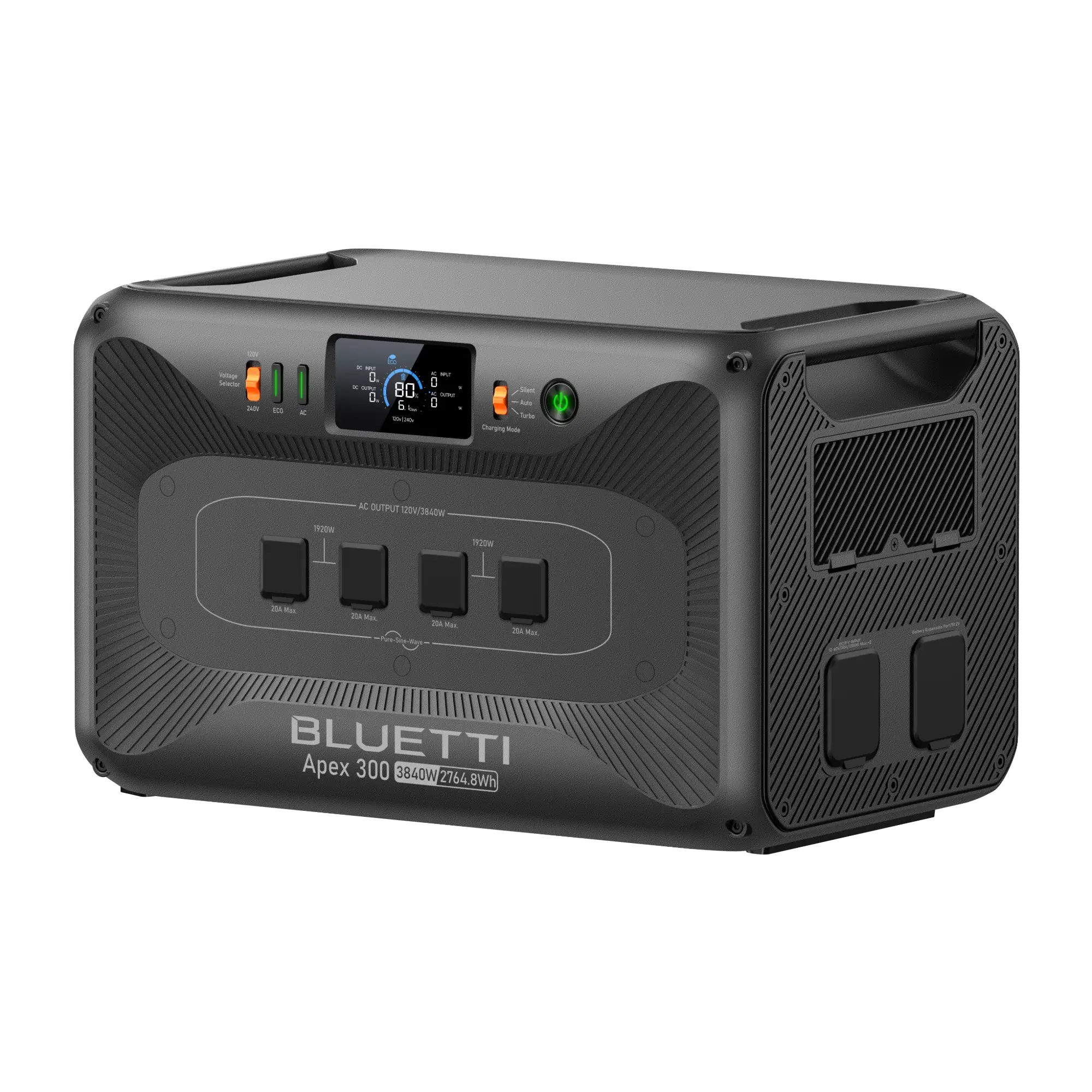
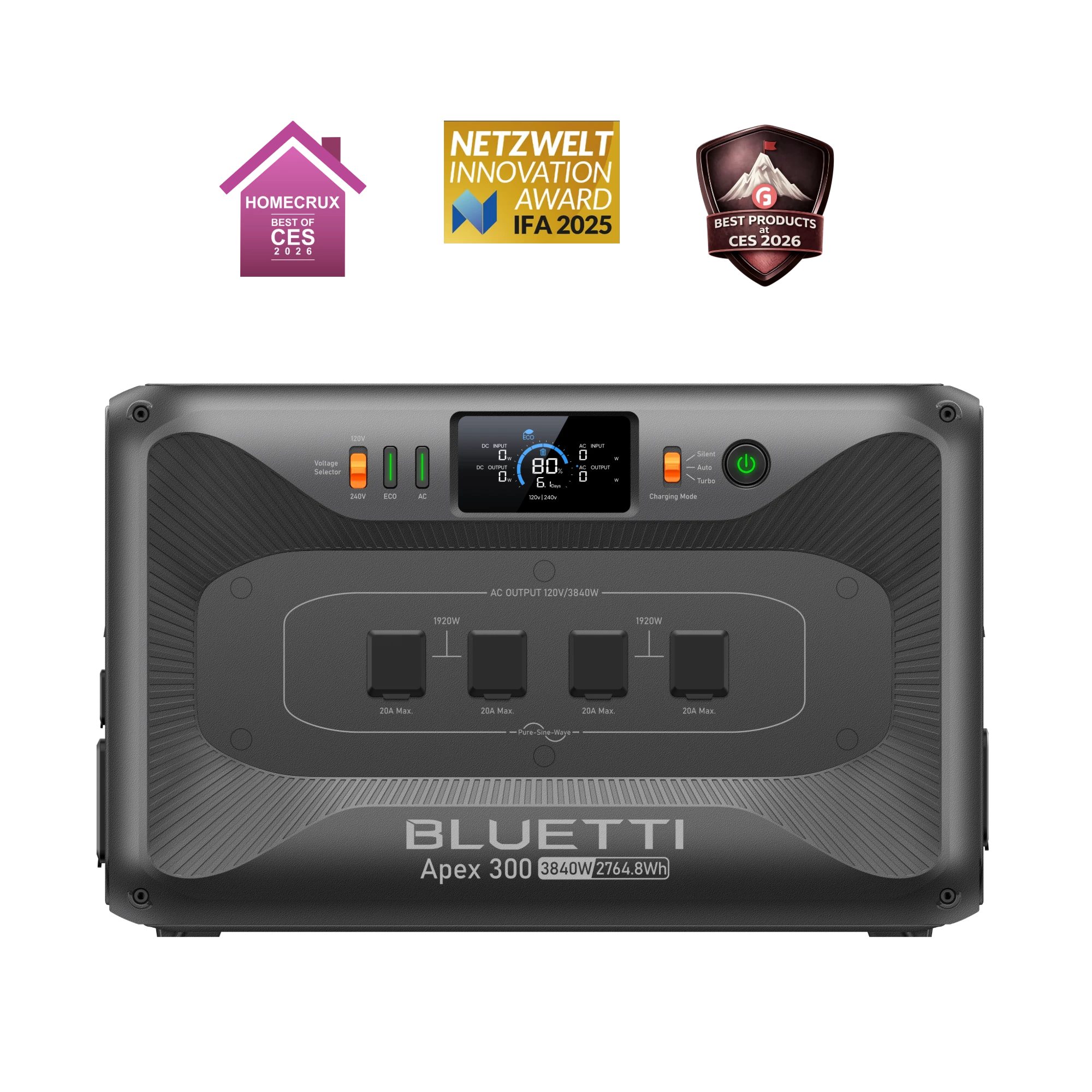
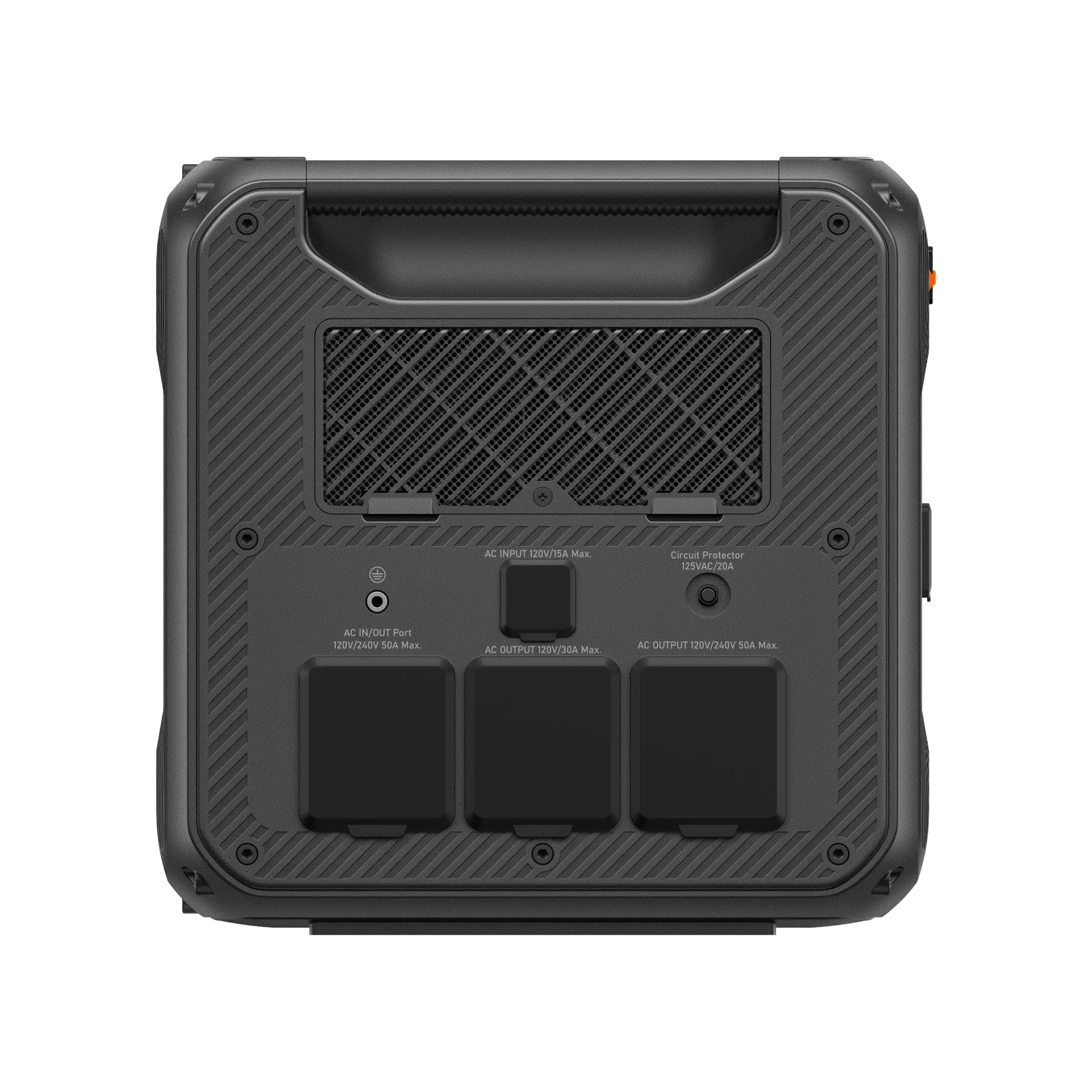
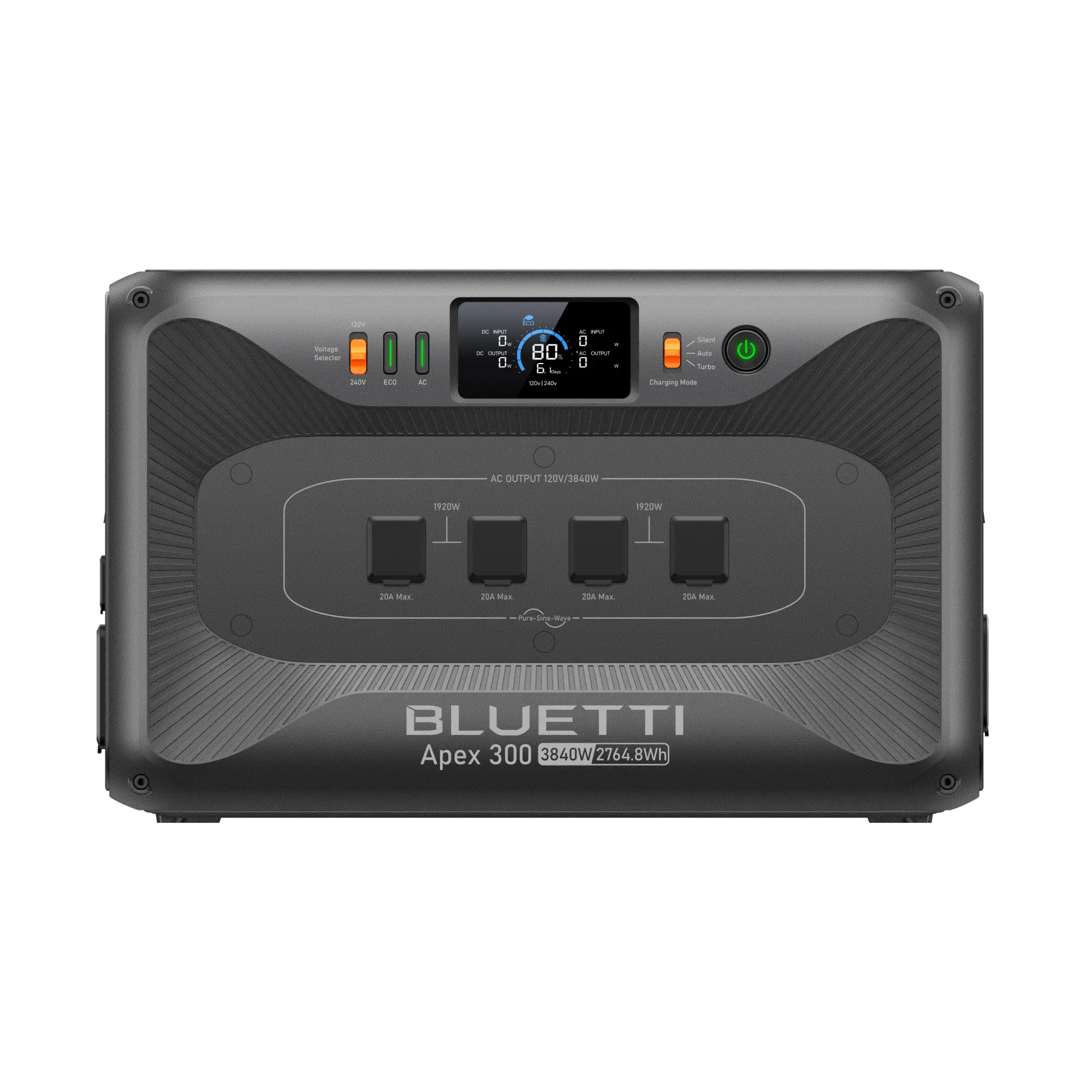
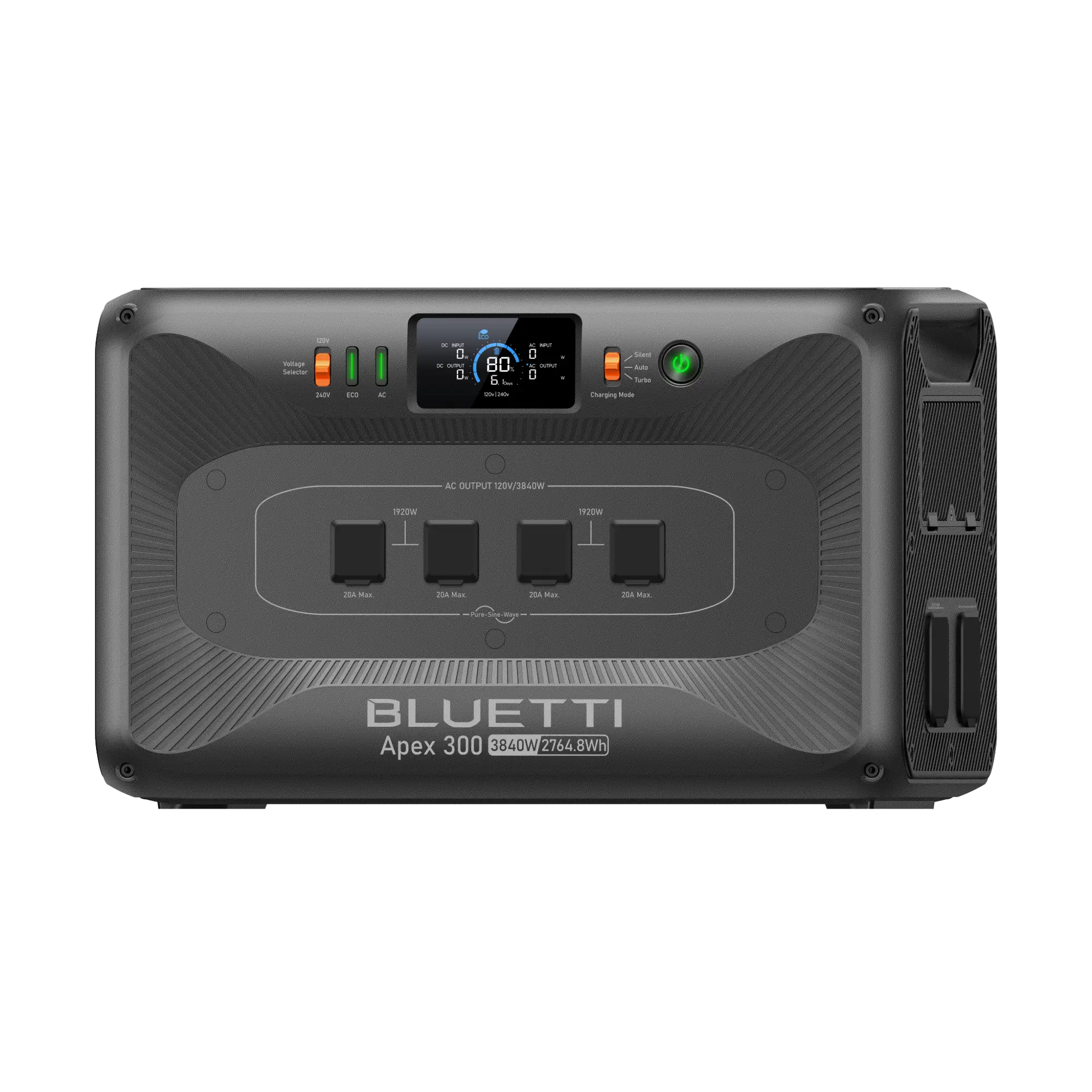
The Apex 300 opens at 2,764.8Wh of capacity and 3,840W of output, with lifting power reaching 7,680W. According to its product listing, additional battery packs let the same system scale from 2.7kWh up to 100kWh of capacity and from 3.8kW up to 11.5kW of output. It runs on 120V/240V dual output, so it can serve standard outlets and larger appliances at the same time. The unit uses EV-grade LiFePO₄ chemistry rated for a 17-year battery life, paired with a 0ms UPS switchover for backup that does not interrupt connected devices.
Expandable Battery Modules and System Growth
The battery-pack combinations in the Apex 300 lineup show how far a single base unit can stretch in practice. Adding a B300K pack raises total capacity to 5,529.6Wh while keeping the same 3,840W output and 7,680W surge rating. Stepping up further, the Apex 300 paired with a B500K reaches 7,884.8Wh, and combining two Apex 300 units with two B300K packs and a Hub A1 pushes the system to 7,680W output and 11,059.2Wh of capacity. Beyond battery packs, bluettipoweraaa also offers a FridgePower unit built specifically for refrigerators and freezers, with a slim 75mm profile meant to fit behind or beside the appliance it serves.
Multiple Charging Methods for Off-Grid Independence
Reliability away from fixed power depends on how a system recharges, not only on how much it stores. The Apex 300 accepts generator charging at up to 11.5kW across 120V/240V, along with solar input reaching up to 19.2kW when paired with the SolarX 4K accessory. The Elite 300 appears in bundles that include solar panels rated at 350W or 500W for charging away from a wall outlet. Elsewhere in the lineup, AC TurboBoost charging appears on smaller Elite models, with the Elite 100 V2 reaching 80% charge in 45 minutes through a 1,200W AC input.
Real-World Performance: Output, Runtime, and UPS Backup Features
Performance in practice comes down to how much load a unit can carry and how fast it reacts once an outage begins. The Elite 400, another model in the home backup range, offers 3,840Wh of capacity with 2,600W of output, sitting between the Elite 300 and the larger Apex-based systems. A few features repeat across the lineup, including fast UPS switchover, app-based monitoring over Bluetooth and Wi-Fi, and surge headroom above the rated continuous output. As a result, comparing models often comes down to capacity and output figures rather than learning a different interface for each one.
- The Elite 300 delivers 2,400W continuous output with a 4,800W lifting capacity and 3,014Wh of stored energy.
- The Apex 300 starts at 3,840W output and 2,764.8Wh capacity, expandable to 100kWh with additional battery packs.
- Both the Elite 300 and Apex 300 use LiFePO₄ battery chemistry, with the Apex 300 rated for a 17-year battery life.
- The Apex 300 accepts generator charging up to 11.5kW and solar charging up to 19.2kW with the SolarX 4K accessory.
- The Elite 300 includes a TT-30 RV outlet and a 12V/30A DC port for direct recreational vehicle connections.
- The FridgePower accessory has a 75mm slim profile built specifically for refrigerator and freezer backup.
Choosing between a self-contained portable power station and an expandable battery system generally depends on how a space is used and how much runtime matters during an outage. A cabin with no permanent wiring may rely on a single unit, while a home with heavier appliance loads might favor a system that can add capacity in stages. That distinction runs across the bluettipoweraaa range, from the single-unit Elite series to the battery-pack-based Apex 300 configurations, and it shapes how each product fits RV travel, cabin living, or home backup.
Added in stages or bought as one unit, a portable power station remains a practical answer for keeping the essentials on when the grid cannot be relied upon.